

For modern banks, income, employment and asset verification are essential for preventing fraud and enhancing the customer experience. Performing comprehensive verifications can also help your organization comply with state and federal regulations.
Unfortunately, traditional verification methods often fall short, leaving banks scrambling to manage risk and protect their reputations. Learn more about how advanced income verification can help you avoid these potential pitfalls.
Challenges of Traditional Verification in Banking
Banks encounter several challenges during the traditional income and employment verification process, such as:
- Lack of real-time data: If you use traditional verification methods, you receive data that’s weeks or months out of date. A lack of real-time data can impact the decision-making process and increase the risk of defaults.
- Security risks: Traditional verification relies on databases vulnerable to hacking attempts and other security concerns. Additionally, traditional verification may include emailing sensitive documentation, also prone to risk.
- High operational costs: Other traditional verification methods take much longer than modern ones. For example, if you use manual verification, you have to wait for every applicant’s employer to respond to your request or potentially call employers multiple times. The more time your employees spend on verification activities, the more it costs your organization to close each loan.
- Extensive paperwork: Manual processes often require significant back-and-forth with borrowers to collect and verify documentation. This inefficiency increases the operational overhead for banks, as employees must spend considerable time manually reviewing and processing paperwork instead of focusing on higher-value tasks.
Why Modern Banking Needs Advanced Verification Solutions
The banking industry is always evolving, along with consumers’ expectations. Applicants don’t want to wait weeks or months to complete the approval process. They expect lenders to provide fast, efficient services, especially when it comes to income and employment verification for home loans.
Banks also face increased regulatory pressures, which creates additional compliance challenges. For example, banks must comply with several anti-money laundering (AML) requirements, including Know Your Customer (KYC).
KYC requires banks to verify their customers’ identities and take additional steps to prevent illegal activities. Traditional verification processes are vulnerable to fraud, making it difficult for banks to comply with the KYC guidelines.
Financial institutions also need to comply with state-specific privacy laws. For example, if you complete employment verification in California, you must adhere to the California Consumer Privacy Act. Since traditional verification methods involve multiple individuals and organizations, they may interfere with your ability to comply with the CCPA.
Traditional solutions also fail to scale effectively as a business grows. Manual verification is simple when you serve dozens of customers per month, but it can be cumbersome if you work with thousands.
Benefits of Digital Verification Solutions
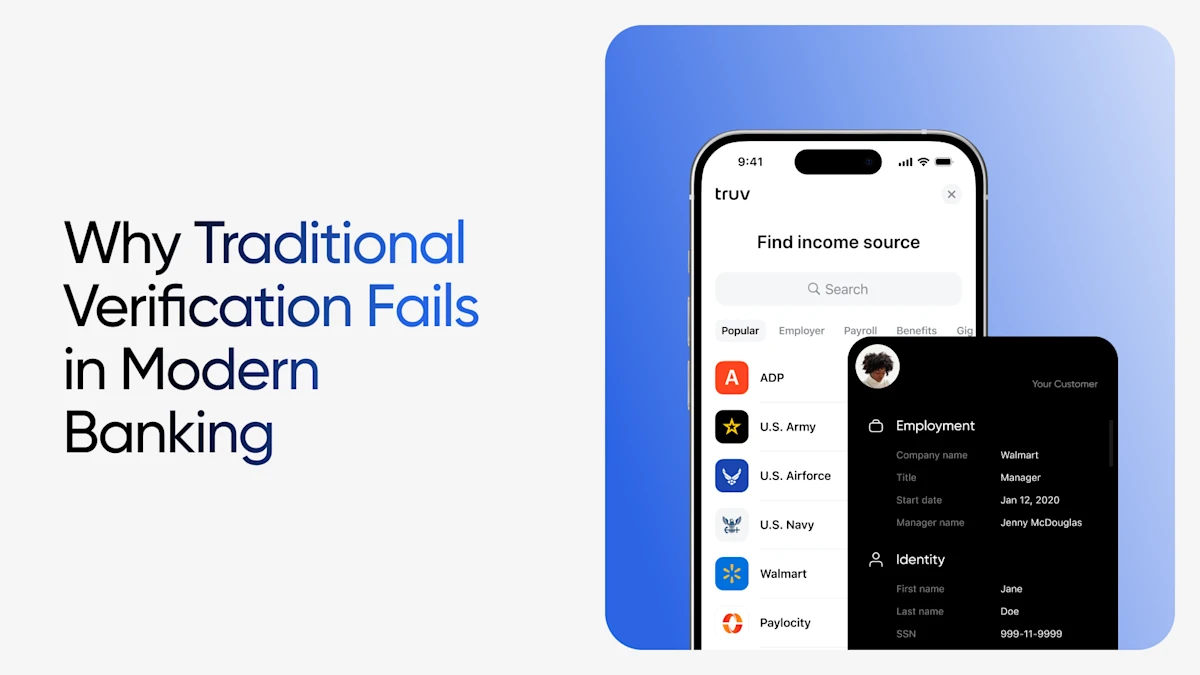
Consumer-permissioned, or digital, verification solutions give you real-time access to the data needed to make informed decisions. Instead of waiting for companies to provide income and employment verifications or chasing applicants for more information, you can receive real-time data in a few seconds, minutes, or hours, depending on how a solution like Truv’s platform is implemented in the bank’s workflow and existing systems, and how long the customer takes to complete the fast and easy verification process.
Suite of Verification Solutions
Truv understands that offering a one-stop platform to address a multitude of verification and other member needs, which is critical for cost-efficiency and ease of vendor management. Truv has built a waterfall solution, providing access to multiple verification methods in a single, easy-to-use platform. With Truv, you can seamlessly access income and employment verification, asset verification, a document processing fallback solution — all through one vendor.
Industry Leading Coverage
Unlike other consumer-permissioned data platforms, Truv’s product suite connects to multiple data sources, offering unmatched breadth and reliability. With connectivity via APIs to 91+ payroll providers, 2.3M+ employers, and 13K+ financial institutions, Truv enables applicants to authenticate access to required bank and payroll data. This eliminates the need for paper copies of bank statements or pay stubs, streamlining the process for both consumers and lenders.
Access to real-time data not only enhances a bank’s decision-making capabilities but also improves customer satisfaction, grows account primacy, and increases member retention. Truv’s innovative solutions ensure your institution is equipped to meet modern banking needs efficiently and effectively.
Enhanced Security
Whether you’re performing federal employment verification or income verification for a loan, security is a top priority. Truv’s consumer-permissioned data platform is designed with advanced security measures, including multiple layers of encryption. These technologies help reduce the risk of unauthorized access to sensitive applicant data.
Truv’s modern verification process also eliminates the need to collect and store paper copies of tax returns, pay stubs, and other confidential documents, further safeguarding consumer information.
Using Truv’s digital income and employment verification process significantly reduces the risk of fraud. By connecting directly to payroll providers and financial institutions through secure APIs, Truv eliminates reliance on easily falsified paper documentation, such as tax returns or pay stubs. This direct connection makes fraudulent activity much less likely, giving your institution greater confidence in its verification outcomes while maintaining the highest standards of data security.
Key Digital Verification Tools for Banks
Once you master the meaning of employment verification, you need a way to streamline the verification process. Truv’s platform is 95% API-based and automates connections to verified data sources quickly and seamlessly.
Verification of income and employment (VOIE) via consumer-permissioned data is becoming increasingly widespread amongst tech-forward financial institutions, as real-time data. Truv’s VOIE solution supports several VOIE scenarios, such as co-borrowers with full-time employment or a single borrower with self-employment income from several sources.
The Future of Verification in Banking
The banking industry is always changing, so the verification process needs to adapt accordingly. Going forward, we expect to see verification providers introducing artificial intelligence (AI) and advanced analytics into their business models.
Regulations are also likely to change, making it critical for banks to invest in enhancing security and improving efficiency. Overall, customer-centric, tech-forward banks need to embrace innovative verification solutions to future-proof their operations.
All-In-One Vendor
For simplified vendor management and cost efficiency, Truv is designed to be a one-stop solution for banks, offering not only a suite of verification products, but also Direct Deposit Switch (DDS), a comprehensive tool that simplifies the hassle of manual deposit switching while driving account primacy growth.
Truv’s DDS has already shown measurable success in driving account primacy and improving customer satisfaction. For instance, B9 realized a 12% improvement in total funds deposited after implementing Truv’s DDS solution, showcasing the platform’s ability to strengthen member relationships and grow deposits effectively.
With Truv’s DDS, financial institutions can achieve:
- Increased New Member Acquisition: Truv’s DDS provides a seamless, friction-free experience for customers, making it easier to switch direct deposits. This improves satisfaction among both new and existing members, driving higher acquisition rates and fostering loyalty.
- Growth of Existing Relationships: Truv empowers banks to segment and protect their current member base using deeper insights from enhanced data connectivity. This ensures existing relationships remain strong and continue to grow over time.
- Cost Reduction: By streamlining the onboarding process and automating key steps, Truv’s DDS lowers acquisition costs and eliminates one-time payment costs associated with manual processes.
- Increased Operational Efficiency: Truv reduces customer friction by automating direct deposit changes, minimizing support phone calls, and enhancing the overall user experience. This efficiency allows bank staff to focus on high-value activities instead of manual tasks.
Request a demo to see Truv’s modern solutions in action.
FAQs
The following frequently asked questions provide more information about traditional and digital verification methods.
Why do traditional verification methods fail in modern banking?
Traditional verification methods fail because they rely on outdated data and are susceptible to fraud, while also not meeting customer expectations around fast and digital processes
What are the benefits of digital verification for banks?
Digital verification helps banks save money, increase efficiency and provide a better customer experience.
How does real-time verification improve security?
Real-time verification improves security because it allows you to connect directly to banks and payroll providers. When you get data right from the source, there’s a lower risk of fraud.
What Truv products are available for banking?
Truv offers several tools for digital verification in banking, including verification of income, employment and assets, direct deposit switch, and paycheck pay.


